


Addressing a Double Chin: Practical Solutions and Medical Insights

A double chin is one of the most common cosmetic concerns people bring up with their doctors, and it is far more normal than social media might have you believe. It affects people of all ages, body types, and fitness levels, and in most cases, it says nothing meaningful about your overall health. Still, it is a part of your appearance that can affect how you feel in photos, in meetings, or simply when you look in the mirror.
This article respects that. The goal here is not to tell you that you need to change anything, but to give you honest, evidence-based information if you do want to explore your options. From free at-home strategies to non-surgical treatments to surgery, there are real solutions across every budget. What works depends heavily on what is causing yours in the first place.
What Causes a Double Chin
Understanding the root cause of your double chin is the single most important step before choosing any treatment. The same area of fullness under the jaw can have very different drivers, and what resolves one type may do nothing for another.
| Cause | Mechanism | Who It Tends to Affect |
| Excess body weight | Increased subcutaneous fat deposits under the jaw and neck | People carrying extra weight overall |
| Genetics | Inherited a smaller chin projection or weaker jawline bone structure | Can affect lean individuals with no weight gain |
| Aging | Skin loses collagen and elasticity; the platysma muscle weakens after the mid-30s | Adults 35 and older |
| Posture (tech neck) | Chronic forward head position weakens neck muscles and compresses the area | Heavy screen users, desk workers, and teenagers |
| Fluid retention | Lymphatic or hormonal factors cause temporary puffiness under the jaw | Younger patients, those with high sodium intake or hormonal changes |
If your double chin appeared suddenly rather than gradually, especially if it came with swelling or changes in breathing, that warrants a prompt visit to your doctor to rule out thyroid or lymph node issues, which are unrelated to cosmetic concerns.
Lifestyle and At-Home Solutions
For many people, especially those whose double chin is driven primarily by weight or posture, consistent lifestyle changes deliver noticeable improvement over time. These are not quick fixes, but they are free, safe, and have benefits that extend far beyond your jawline.
Weight management is the most direct lever if excess body fat is the main driver. You cannot spot-reduce fat from one area through diet alone, but losing body fat overall almost always reduces submental fullness. A balanced, calorie-aware approach focused on whole foods, adequate protein, and reduced ultra-processed food tends to work better long-term than any restrictive diet.
Posture correction is underestimated. Chronic forward head posture, which is increasingly common with widespread smartphone and laptop use, weakens the muscles that support the neck and jaw. Adjusting your monitor to eye level, keeping your phone higher when scrolling, and taking regular movement breaks can all reduce the mechanical compression that worsens the appearance of a double chin. Strengthening your upper back and posterior chain through exercise also pulls the head back into alignment over time.

Hydration and sodium reduction matter more than most people expect. When sodium intake is high and water intake is low, the body retains fluid in the face and neck, adding puffiness that reads as a double chin. Drinking enough water throughout the day and moderating processed food intake can reduce this within days for some people.
Sleep position and duration play a smaller but real role. Sleeping on your back reduces fluid pooling in the face overnight. Getting adequate sleep (7 to 9 hours for most adults) also supports healthy cortisol levels, which in turn influences fat distribution and inflammation.
Five Targeted Chin and Neck Exercises
Double chin exercises target the platysma and other muscles in the neck and jaw region. It’s important to set realistic expectations: these moves can tone and strengthen the area, improving firmness and contour, but they do not directly reduce submental fat. They work best as a complement to other solutions, whether lifestyle, non-surgical, or surgical, not as a cure on their own.
- Chin lifts — Tilt your head back toward the ceiling, pucker your lips as if kissing the sky, and hold for 5 seconds before releasing. 10 reps, 2 sets daily.
- Tongue press — Sitting upright, press your tongue firmly against the roof of your mouth and hold while lowering your chin slightly toward your chest. Hold for 15 seconds, 5 reps daily.
- Neck rotations — Slowly roll your head in a full circle, keeping your shoulders relaxed. 5 rotations in each direction, daily. Stop if you feel sharp pain.
- Jaw jut — Tilt your head back, then push your lower jaw forward until you feel a stretch under the chin. Hold 5 seconds and release. 10 reps, 2 sets daily.
- Lip pulls — Tilt your head back, press your lower lip over your upper lip as far as possible, and hold while feeling the stretch in the jaw and neck. 15-second holds, 10 reps daily.
Non-Surgical Medical Treatments
Non-surgical options for reducing submental fat have expanded considerably over the past decade, and for many patients, they offer meaningful results without the recovery time of surgery. The right choice depends on whether the primary issue is excess fat, loose skin, or both.
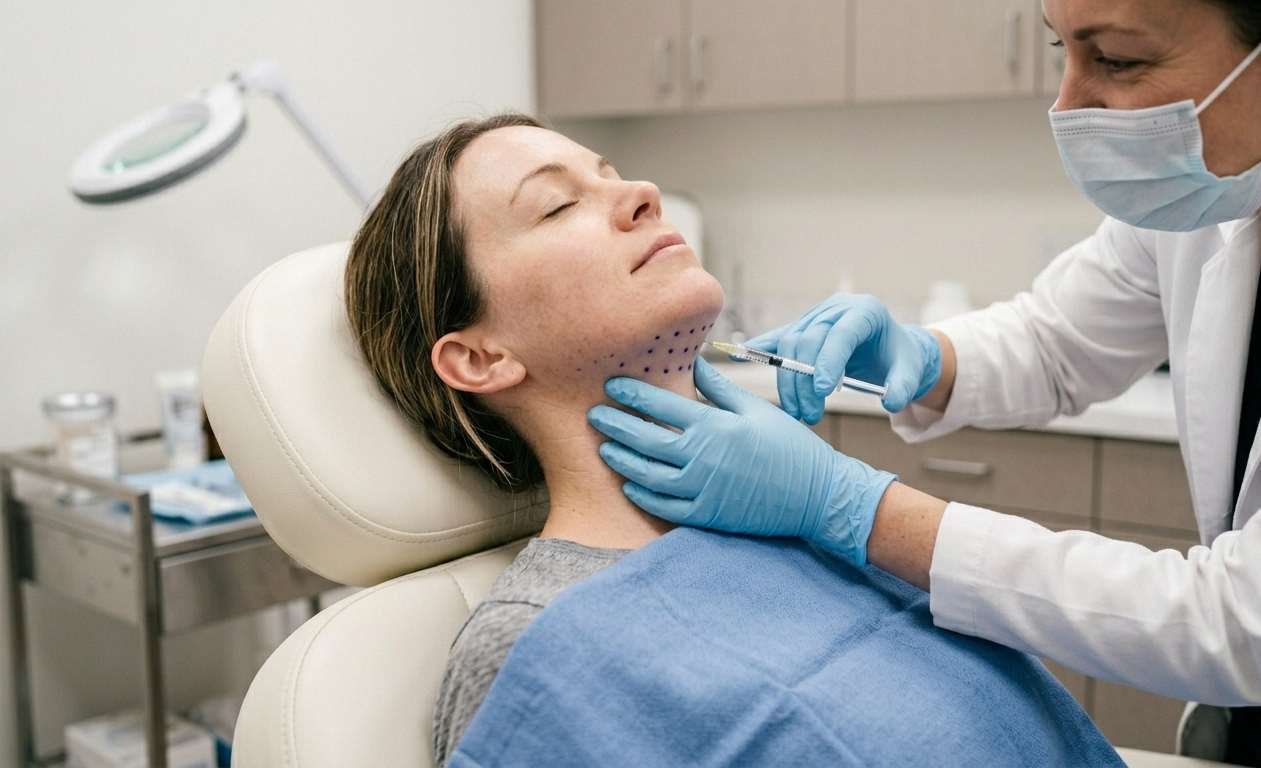
Kybella treatment (deoxycholic acid injections) is the only FDA-approved injectable specifically for submental fat (meaning fat beneath the chin that causes a double chin). Deoxycholic acid is a naturally occurring molecule that disrupts fat cell membranes, causing them to break down and be absorbed by the body. Most patients require 2 to 4 treatment sessions spaced at least one month apart, with visible results emerging over 4 to 6 months. Swelling and tenderness after each session are common and typically resolve within 1 to 2 weeks. You can read more about the FDA’s Kybella approval documentation for the full clinical background.
CoolSculpting chin (cryolipolysis) uses controlled cooling to freeze and destroy fat cells beneath the skin without damaging the surface. For the chin specifically, a small applicator targets the submental area in a 35 to 45-minute session. Most patients need 1 to 2 sessions, with results visible over 8 to 12 weeks as the body clears the destroyed cells.
Ultherapy (focused ultrasound) does not target fat directly. Instead, it delivers ultrasound energy to the deeper layers of skin and the tissue beneath it, stimulating collagen production and tightening lax skin over 3 to 6 months. It is best suited for patients whose main concern is skin looseness rather than fat volume.
Radiofrequency treatments (such as Thermage or Morpheus8) work similarly to Ultherapy in that they tighten skin and stimulate collagen, with the added benefit of some mild fat reduction in certain devices. They are often used as a complement to fat-reduction treatments.
Mesotherapy involves injecting a cocktail of lipolytic compounds into the fat layer. It has been used for decades in Europe and Latin America, but it is less standardized than Kybella, and outcomes vary more widely depending on the formulation and provider.
| Treatment | Downtime | Sessions Needed | Average Cost (USD) | Best Candidate |
| Kybella | 1 to 2 weeks of swelling per session | 2 to 4 | 1,200 to 1,800 per session | Mild to moderate submental fat, good skin elasticity |
| CoolSculpting (chin) | Minimal, 1 to 3 days of tenderness | 1 to 2 | 700 to 1,500 per session | Pinchable submental fat, good skin tone |
| Ultherapy | None to minimal | 1 (maintenance yearly) | 1,500 to 3,500 | Mild skin laxity, not primarily fat |
| Radiofrequency | Minimal | 3 to 6 | 500 to 1,500 per session | Skin laxity with mild fat |
| Mesotherapy | 1 to 3 days | 4 to 8 | 250 to 600 per session | Mild fat, patients seeking a lower-cost option |
Surgical Options
Surgery delivers the most dramatic and lasting results, and it is the appropriate choice for patients with significant submental fat, skin laxity, or both, particularly when non-surgical treatments have not achieved the desired outcome.
Chin liposuction (submental liposuction) is the most common surgical approach for getting rid of a double chin. A small cannula is inserted through a tiny incision under the chin to remove excess submental fat directly. The procedure is typically performed under local anesthesia with sedation, takes about one hour, and involves 1 to 2 weeks of downtime with a compression garment. It works best for patients under 50 with good skin elasticity, since the skin needs to retract smoothly after fat removal. According to the American Society of Plastic Surgeons, chin liposuction is among the most commonly performed minimally invasive procedures for double chin reduction.
Surgery delivers the most dramatic and lasting results, and it is the appropriate choice for patients with significant submental fat, skin laxity, or both, particularly when non-surgical treatments have not achieved the desired outcome.

Neck lift (cervicoplasty or platysmaplasty) addresses not just fat but the underlying muscle and excess skin. A platysmaplasty tightens the platysma bands that can cause vertical cords in the neck, while cervicoplasty removes redundant skin. Recovery is longer, typically 2 to 4 weeks, but the results are more comprehensive and better suited to patients over 50 or those with pronounced skin sagging.
Combined procedures are common when both fat and skin laxity are present. A surgeon might perform liposuction alongside radiofrequency-assisted skin tightening, or combine a neck lift with a lower facelift for patients seeking overall facial rejuvenation. Discussing goals openly with a board-certified plastic surgeon helps determine the most efficient combination.
What Actually Works for Most People
This is the section worth reading carefully, because honest expectations are the difference between spending money wisely and being disappointed.
- If excess weight is the main driver, reducing overall body fat is both the most effective and most durable solution. A double chin caused by weight almost always improves meaningfully with fat loss.
- If genetics is the primary factor, lifestyle changes alone rarely produce dramatic changes. Non-surgical or surgical intervention is more likely to deliver visible results in this group.
- Combination approaches consistently outperform single methods. A patient who does Kybella while also improving posture and reducing sodium will see better outcomes than someone who relies on injections alone.
- Results from non-surgical treatments are gradual. Kybella and CoolSculpting results emerge over months, not days. Managing expectations around timing prevents early abandonment of treatments that are actually working.
- Exercise tones the area but does not eliminate fat. Treating chin exercises as fat-loss tools leads to frustration; treating them as a supportive complement to other changes is more realistic.
The American Society for Dermatologic Surgery offers a useful patient resource comparing non-surgical body contouring options, which is worth reviewing before committing to any injectable treatment.
When to Talk to a Professional
Most double chins are cosmetic and do not require medical attention beyond a consultation for treatment. However, you should see a doctor promptly rather than a cosmetic provider if:
- Your double chin appeared suddenly over days or weeks, rather than gradually.
- There is visible swelling, firmness, or a lump in the area.
- You notice difficulty swallowing or any breathing changes.
- Fullness persists despite meaningful weight loss (thyroid issues, among other conditions, can cause neck fullness)
- You are experiencing fatigue, unexpected weight gain, or cold intolerance alongside neck fullness, as these may suggest a thyroid condition worth evaluating.
If you are simply exploring your options for a long-standing cosmetic concern, a board-certified dermatologist or plastic surgeon is the appropriate starting point. They can assess your skin elasticity, fat distribution, and structural anatomy to recommend the most effective approach for your specific situation. Similarly, if you have concerns about your oral structure influencing your chin or jaw appearance, a consultation that also covers related topics like laser-based aesthetic procedures may offer additional perspective.
Expert Perspective
“When a patient comes in asking about their double chin, the first thing I assess is whether we are dealing primarily with fat, skin laxity, or both. For a 32-year-old with good skin elasticity and a pinchable pocket of fat, Kybella or CoolSculpting is often all they need. For someone in their 50s with significant skin looseness, liposuction alone would leave them disappointed because the skin would not retract fully. In those cases, a neck lift is a more honest conversation. Age and skin quality drive the recommendation far more than the volume of fat alone,” says Dr. Sarah Whitmore, Board-Certified Plastic Surgeon at the Institute for Aesthetic and Reconstructive Surgery.
Frequently Asked Questions
Can chin exercises really get rid of a double chin?
Not on their own. Exercises like chin lifts and tongue presses strengthen and tone the platysma and surrounding neck muscles, which can improve the firmness and contour of the area over time. However, they do not directly burn submental fat. If genetics or excess fat are the main drivers, exercise alone is unlikely to produce a dramatic change. They work best as a supportive habit alongside other approaches.
Does Kybella hurt?
Most patients describe the injections as a burning or stinging sensation during the procedure, which typically lasts a few minutes. Numbing cream is usually applied beforehand. The more notable discomfort comes in the days after treatment, when swelling, bruising, and temporary numbness in the chin area are common. This typically peaks around day 3 and resolves within 1 to 2 weeks.
How long do CoolSculpting results last?
CoolSculpting permanently destroys the treated fat cells, which the body then clears over 8 to 12 weeks. Because fat cells do not regenerate, those specific cells are gone for good. However, if you gain significant weight after treatment, remaining fat cells in the area can still enlarge. Maintaining a stable weight is the most reliable way to preserve results long-term.
Is liposuction safe for the chin area?
Submental liposuction is one of the more straightforward liposuction procedures, largely because the area is accessible, well-defined, and performed under local anesthesia in most cases. As with any surgical procedure, risks include infection, asymmetry, numbness, and scarring at the small incision site. Choosing a board-certified plastic surgeon with specific experience in facial procedures significantly reduces these risks.
Can a double chin come back after treatment?
It depends on the treatment and the cause. Surgical removal and injectable fat-destruction treatments (Kybella, CoolSculpting) produce lasting results if your weight remains stable. Skin-tightening treatments like Ultherapy address collagen and elasticity, which continue to change naturally with age, so some patients choose maintenance sessions every year or two. If the original cause was weight gain and weight increases again after treatment, fat can return to the area.
This article is for informational purposes only and does not replace professional medical or dental advice, diagnosis, or treatment. Always consult a qualified healthcare provider with questions about your individual condition. Do not delay seeking medical attention because of something you read here.
References
- American Society for Dermatologic Surgery. Body Contouring and Non-Surgical Fat Reduction. asds.net
- American Society of Plastic Surgeons. Neck Lift and Submental Liposuction Overview. plasticsurgery.org
- U.S. Food and Drug Administration. Kybella (deoxycholic acid injection) Approval Summary. fda.gov
- Mayo Clinic. Chin Augmentation and Neck Procedures. mayoclinic.org
- Cleveland Clinic. Double Chin: Causes, Treatments, and Prevention. my.clevelandclinic.org