

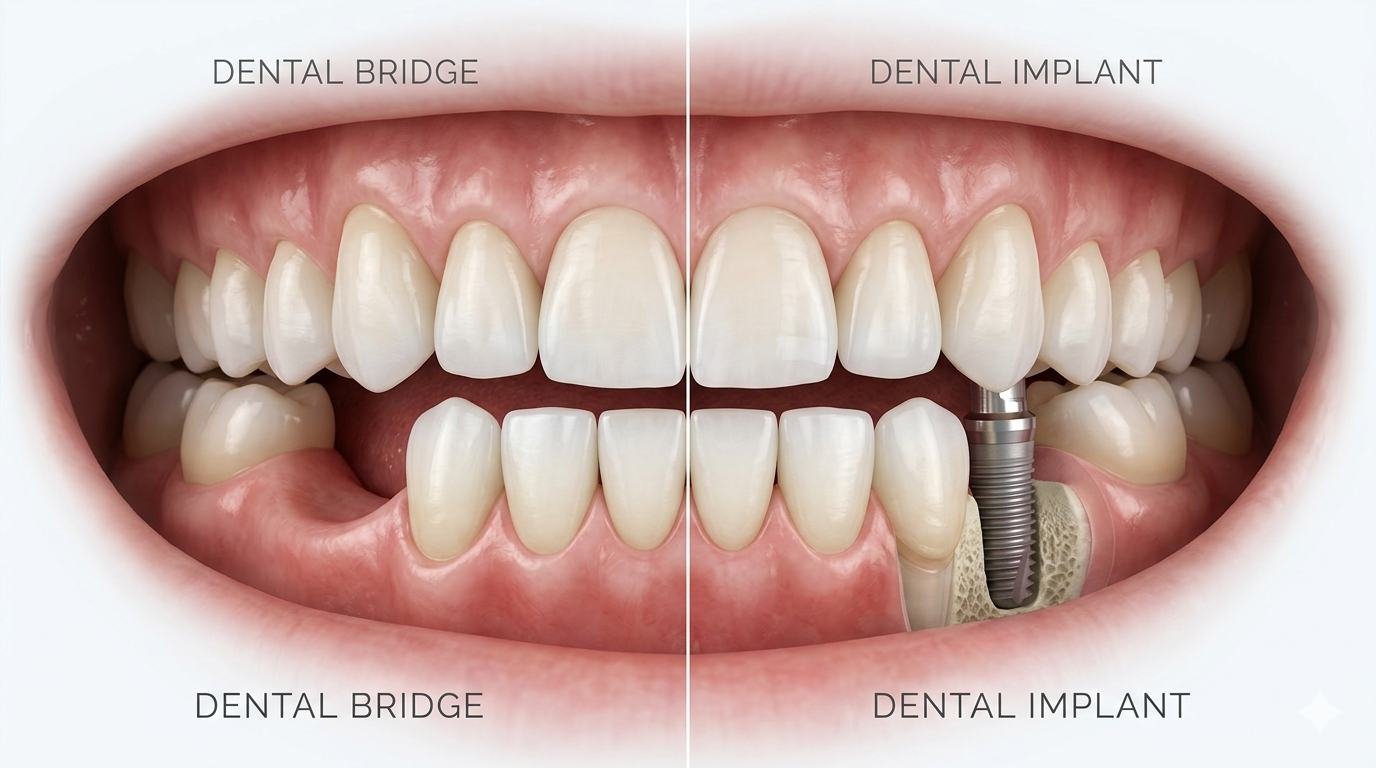

Losing a tooth can feel like more than just a cosmetic issue. It affects how you eat, how you speak, and even how you hold your jaw over time. The good news is that modern dentistry offers reliable solutions, and two stand out above the rest: dental bridges and dental implants. Many patients search for ‘dental bridge vs implant’ when considering their options.
Both can restore your smile and protect your oral health, but they work very differently and suit different patients. If you have been weighing your options and wondering which one is the smarter investment for your situation, this guide will walk you through everything you need to know: how each option works, what the procedures look like, how long they last, what they cost, and which questions to ask your dentist before deciding.
How a Dental Bridge Works
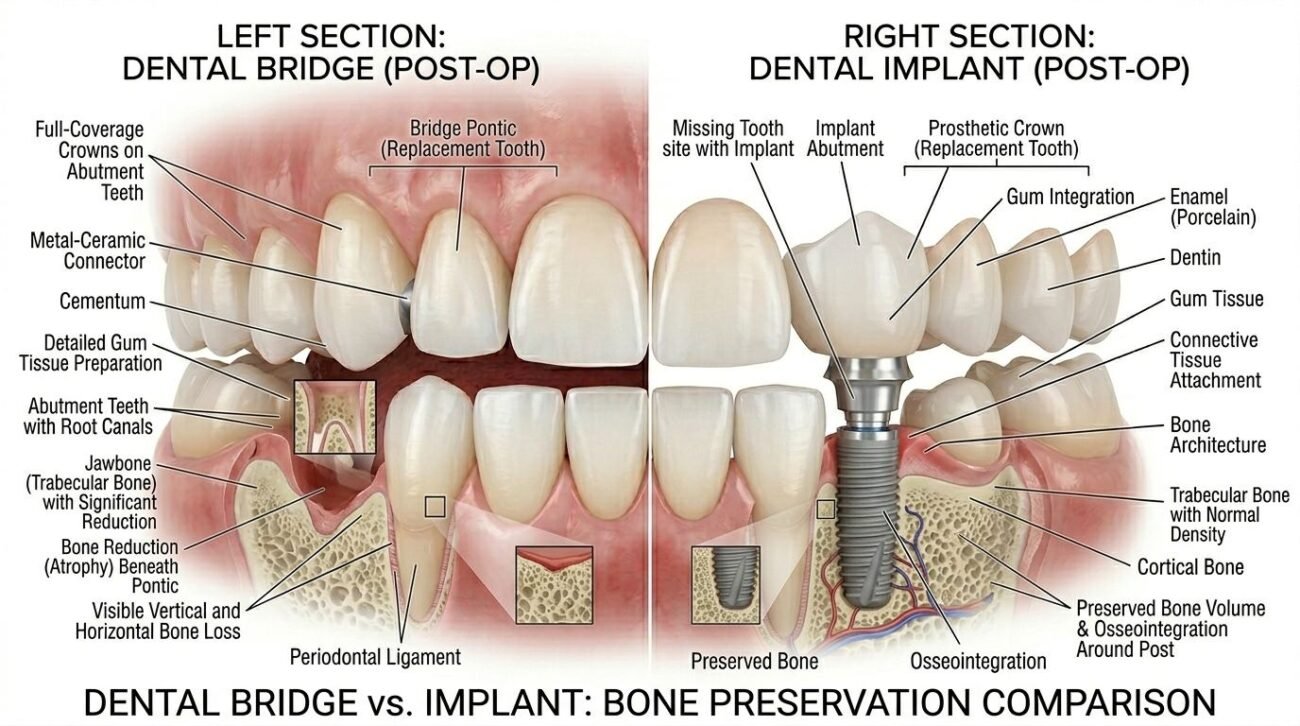
A dental bridge fills the space left by a missing tooth. It uses one or more fake teeth held in place by caps glued onto the healthy teeth next to the gap. These supporting teeth are called abutment teeth.
The procedure usually takes two visits. First, your dentist reshapes the supporting teeth by removing a little bit of their outer layer. Then they take moulds to a lab, where your custom bridge is made. In the meantime, you get a temporary bridge. At the second visit, the permanent bridge is checked and glued into place.
One trade-off with bridges is that healthy nearby teeth must be changed to hold the bridge. According to a systematic review by Borda and colleagues, when preparing teeth to support a dental bridge, the outer enamel layer is permanently removed and does not regenerate, which is why dental professionals often consider bridges more invasive to the surrounding teeth than dental implants.
Bridges are commonly made from porcelain fused to metal, all-ceramic materials, or zirconia. Each has different aesthetic and durability characteristics that your dentist can help you evaluate based on the location of the missing tooth.
Understanding Dental Implants
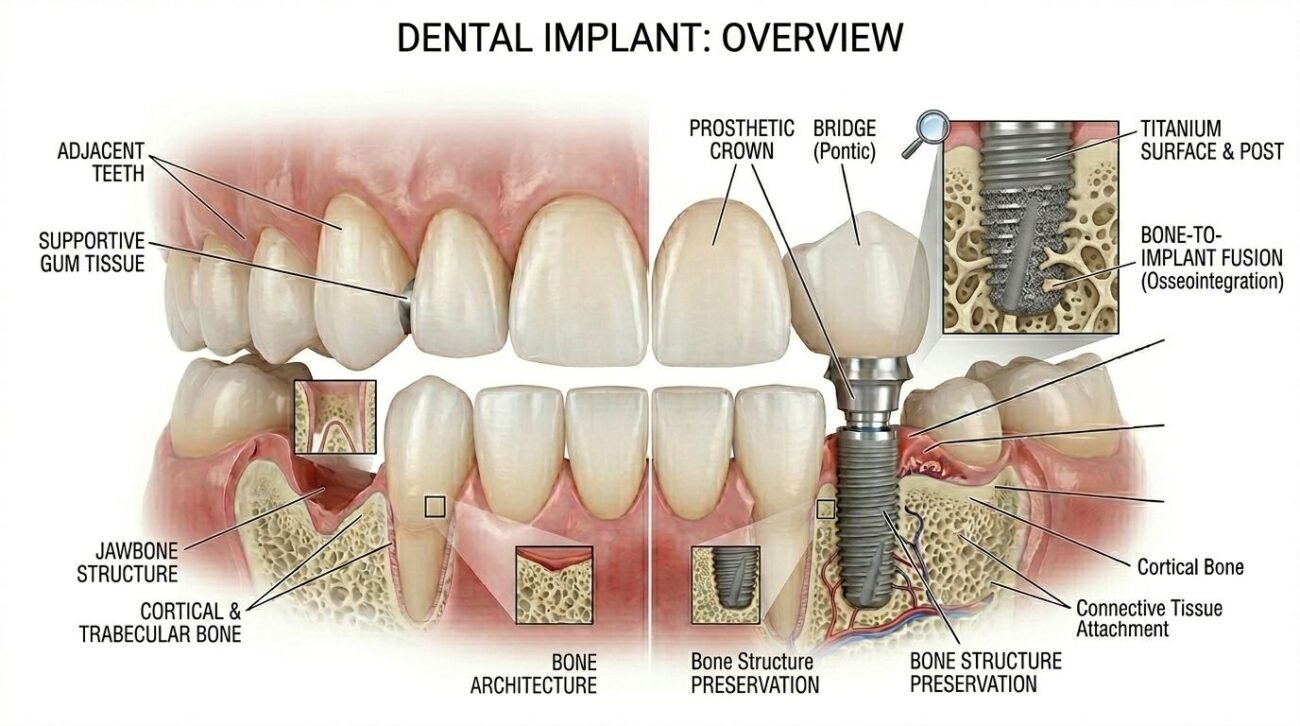
A dental implant is a metal post placed into the jaw. Once it joins with the bone, a custom-made tooth is put on top. This looks and acts almost like a real tooth.
Getting an implant takes longer than getting a bridge. After the metal post is placed, you usually wait 3 to 6 months for it to fuse with the bone. Some patients may be able to finish faster, but this depends on the person.
Implants are placed in the bone and help keep it healthy. If a tooth is lost, the bone underneath shrinks because it isn’t used. While dental implants can help preserve bone and support facial structure, a report notes that there is only limited evidence linking the condition of the teeth adjacent to an implant to the implant’s success, and insufficient evidence to show that implants directly affect nearby teeth. If those teeth are healthy, they stay untouched. You can read more in our article about laser dentistry procedures and benefits.
Side-by-Side Comparison: Dental Bridge vs Implant
Here is a quick overview to make the differences between a dental bridge vs implant easier to see at a glance:
| Feature | Dental Bridge | Dental Implant |
| Procedure type | Non-surgical | Surgical |
| Timeline | 2 to 3 weeks | 3 to 9 months |
| Impact on adjacent teeth | Requires reshaping | No impact |
| Bone preservation | No (bone loss continues) | Yes (stimulates bone) |
| Average lifespan | 10 to 15 years | 15 to 25+ years |
| Cost range (per unit) | PKR 25,000 to 80,000 | PKR 80,000 to 250,000 |
| Maintenance | Regular flossing with a threader | Standard brushing and flossing |
| Suitable for | Patients wanting a shorter timeline or lower upfront cost | Patients seeking long-term investment with bone preservation |
| Insurance coverage | Often partially covered | Less commonly covered |
Note: Cost ranges are estimates and vary by location, material, and clinical complexity. Always confirm with your provider.
Lifespan, Maintenance, and Long-Term Value
When it comes to how long each option lasts, implants generally have the edge. A well-placed implant can last 20 years or more, and many last a lifetime with proper care. The crown on top may eventually need replacement, but the implant post itself rarely fails in a healthy patient.
Bridges typically last 10 to 15 years before needing replacement, though excellent oral hygiene can extend this. Cleaning a bridge requires special flossing tools or water flossers to reach beneath the pontic, as a floss threader or interdental brush is needed to access the area under the artificial tooth.
“In patients with adequate bone density and no uncontrolled systemic disease, a dental implant is often the most biomechanically sound long-term solution because it functions like a natural tooth root and prevents the bone deterioration we consistently see under bridge sites,” says Dr. Amara Hassan, Prosthodontist at Aga Khan University Hospital, Karachi.
From a value perspective, the upfront cost of an implant is higher, but when you factor in the likelihood of replacing a bridge once or twice over 20 years, the lifetime costs often become comparable. The American Dental Association notes that 10-year implant success rates exceed 95 percent in carefully selected patients.
Who Is a Good Candidate for Each Option?
When considering a dental bridge vs. an implant, not every patient is a candidate for both options, and your eligibility depends on several clinical and personal factors.
Candidates who may be better suited for a bridge
Patients who have lost too much bone in the implant area and do not want a bone-building procedure may find a bridge easier to use. People with health problems, like uncontrolled diabetes, active gum disease, or who smoke a lot, may have more risks with implants. A bridge may also be chosen when a tooth needs to be replaced quickly or if the nearby teeth need caps for other reasons.
Children and teenagers whose jaws are still growing should not get implants; bridges are a better temporary or middle-of-the-road option for them.
Candidates who may be better suited for an implant
If the teeth next to your missing tooth are healthy and you want to keep them that way, an implant is the gentler choice. Patients with enough bone, good general health, and who don’t smoke are usually great candidates. Those who want something that feels most like a real tooth and can wait for the process are often happiest with implants.
For patients concerned about related oral health issues, our guide on wisdom tooth eruption and removal explains how tooth loss from extractions can affect your replacement options.
Role of Bone Health in Your Decision
Bone health deserves its own section because it is one of the most significant factors in this decision, and many patients do not consider it until their dentist brings it up during a consultation.
When a tooth is missing, the bone underneath begins to shrink because it is no longer used. According to The Dental Implant Guide, when a tooth is lost in the front of the mouth, the bone can quickly shrink, leading to gum and bone collapse. A dental bridge rests on the gum and does not prevent the bone loss beneath the replacement tooth. An implant, by contrast, integrates with the bone and continues to stimulate bone growth. A bridge sits on the gums and does not fix bone loss under the fake tooth. An implant, on the other hand, connects to the bone and helps keep it healthy, just like a real tooth root does. According to a recent study, cone-beam CT scans are effective for detecting bone loss around dental implants, making them a useful tool for assessing bone volume during the planning phase of implant placement.
Questions to Ask Your Dentist Before Deciding
Walking into a dental consultation prepared can make a big difference in the quality of the conversation and the confidence you feel in your final decision. Consider asking your dentist these questions:
- Am I a good candidate for an implant based on my current bone density and overall health?
- Would my adjacent teeth need crowns anyway, making a bridge more practical?
- What is the expected lifespan of each option in my specific situation?
- What are the total costs, including follow-up appointments, adjustments, and eventual replacement?
- How will each option affect my ability to eat the foods I enjoy?
- Are there any medical conditions I have that increase my risk for one option over the other?
You might also want to get a second opinion if you are unsure, especially when the recommendation involves surgery or significant modification of healthy teeth. Cleveland Clinic provides a helpful overview of what to expect during a dental implant evaluation to help you prepare.
Frequently Asked Questions
Is a dental implant more painful than a bridge?
The implant procedure involves surgery and is performed under local anesthesia, so discomfort during the procedure itself is minimal. Post-surgical soreness in the days following placement is common and manageable with over-the-counter pain relief. A bridge involves less surgical discomfort, but the reshaping of adjacent teeth can cause temporary sensitivity.
Can I get a dental implant if I have already had a bridge?
In many cases, yes. If a bridge fails or needs replacement, your dentist will evaluate whether the bone beneath the missing tooth site is sufficient for an implant. Bone grafting may be needed if significant resorption has occurred over the years.
How long does the dental bridge procedure take from start to finish?
Most patients complete the bridge process in two to three visits over two to four weeks. The first visit involves tooth preparation and impressions, and the second involves placement of the permanent bridge.
Will my insurance cover a bridge or an implant?
Dental insurance typically covers a portion of bridge costs because implants are still classified as cosmetic or elective procedures by many providers. Coverage varies widely, so it is worth confirming with your insurer before making a decision.
Is it possible to replace a bridge with an implant later?
Yes, this is a common transition. If you choose a bridge now due to cost or health factors, converting to an implant later is possible, though the process may require bone grafting if bone loss has occurred under the bridge site.
How soon after tooth extraction can I get an implant?
In some cases, an implant can be placed immediately after extraction. More commonly, a healing period of two to three months is recommended before implant placement. Your oral surgeon will advise based on the condition of the extraction site.
Medical Disclaimer
This article is for informational purposes only and does not replace professional medical or dental advice, diagnosis, or treatment. Always consult a qualified healthcare provider with questions about your individual condition. Do not delay seeking medical attention because of something you read here.
References
- American Dental Association. Dental Implants Overview. ada.org. https://www.ada.org/resources/research/science-and-research-institute/oral-health-topics/implants
- National Institutes of Health, National Library of Medicine. Osseointegration and Alveolar Bone Preservation in Implant Dentistry. PubMed Central. https://www.ncbi.nlm.nih.gov/pmc/articles/PMC7463478/
- Cleveland Clinic. Dental Implants: What to Expect. my.clevelandclinic.org. https://my.clevelandclinic.org/health/treatments/10921-dental-implants
- Pjetursson BE, Tan K, Lang NP, Bragger U, Egger M, Zwahlen M. A systematic review of the survival and complication rates of fixed partial dentures (FPDs) after an observation period of at least 5 years. Clinical Oral Implants Research. 2004;15(6):625-642.
- Moraschini V, Poubel LA, Ferreira VF, Barboza ES. Evaluation of survival and success rates of dental implants reported in longitudinal studies with a follow-up period of at least 10 years: a systematic review. International Journal of Oral and Maxillofacial Surgery. 2015;44(3):377-388.
- Aghaloo TL, Moy PK. Which hard tissue augmentation techniques are the most successful in furnishing bony support for implant placement? International Journal of Oral and Maxillofacial Implants. 2007;22(Suppl):49-70.
DOI: Not separately indexed; available via PubMed PMID 17682622 - Mayo Clinic. Dental Implant Surgery. mayoclinic.org. https://www.mayoclinic.org/tests-procedures/dental-implant-surgery/about/pac-20384622