

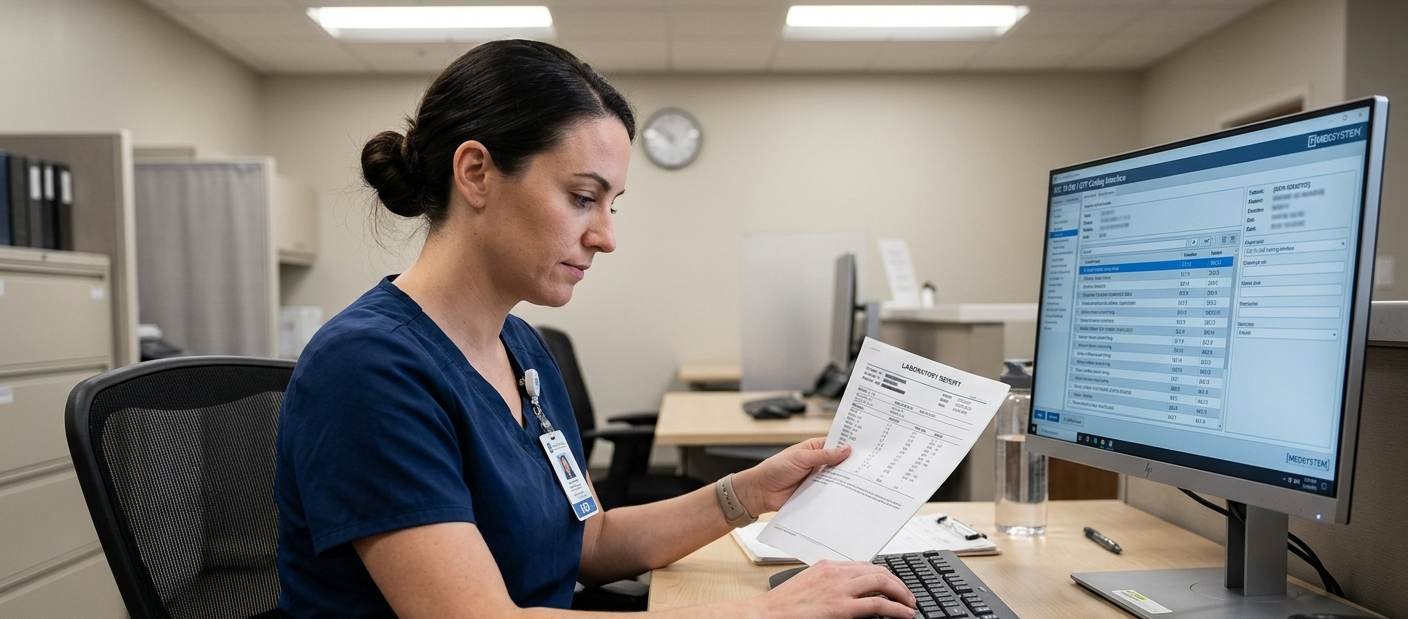
Hypokalemia ICD-10 Code: E87.6 Explained For 2026 With Clinical Context

Whether you are a medical coder verifying a claim, a nurse documenting a patient encounter, or a patient reviewing your own records, knowing the correct hypokalemia ICD 10 code matters. The code is E87.6, and it is billable under the FY2026 ICD-10-CM Official Guidelines effective October 1, 2025, through September 30, 2026. This article covers the E87.6 code in full: where it sits in the ICD 10 hierarchy, what hypokalemia means clinically, the documentation requirements for accurate ICD 10 hypokalemia billing, common coding pitfalls, and the related electrolyte disorder codes you need to know.
What is the hypokalemia ICD 10 code?
The hypokalemia ICD 10 code is E87.6. It is a billable, specific diagnosis code under the ICD-10-CM system maintained by the Centers for Medicare and Medicaid Services. The E87.6 code is valid for FY2026, covering encounters from October 1, 2025, through September 30, 2026. This low potassium ICD code applies to both inpatient and outpatient settings and does not require additional characters for specificity.
Where E87.6 falls in the ICD 10 hierarchy
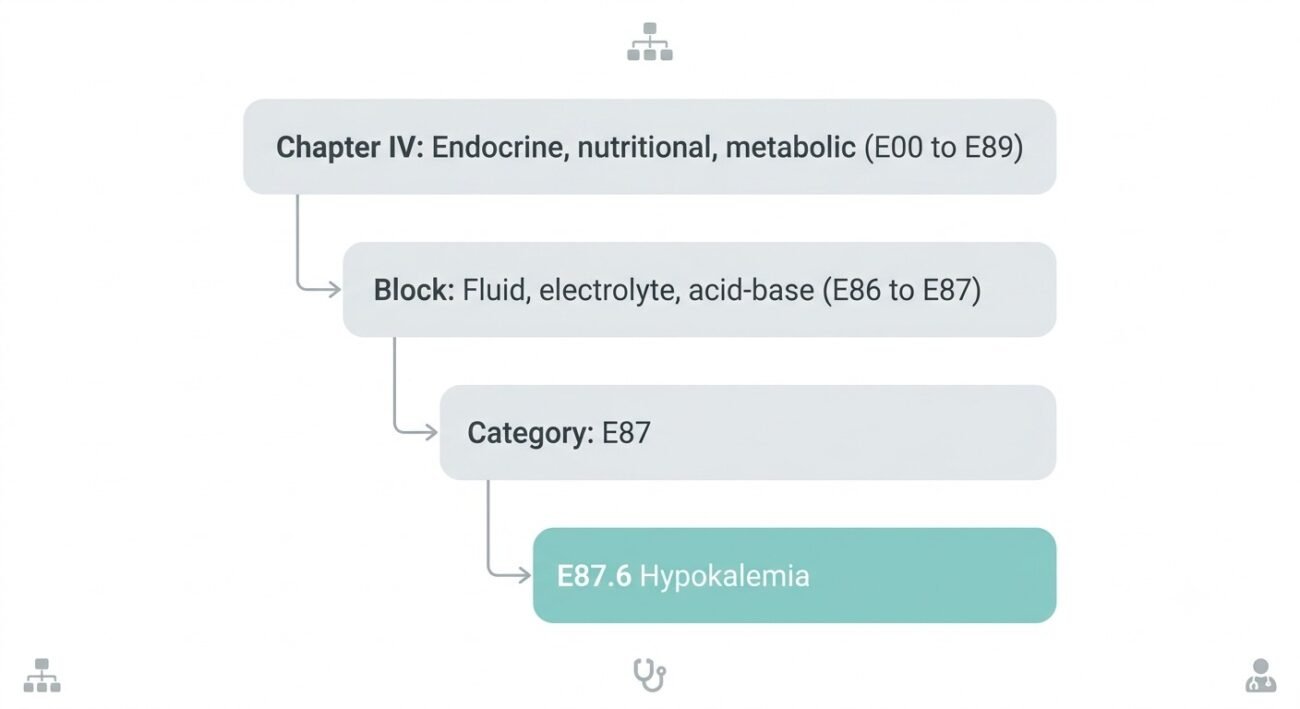
- Chapter IV: Endocrine, nutritional and metabolic diseases (E00 to E89).
- Block: Other disorders of fluid, electrolyte and acid-base balance (E86 to E87).
- Category: Other disorders of fluid, electrolyte and acid-base balance (E87).
- Specific code: E87.6, Hypokalemia.
For a broader overview of electrolyte coding, see our article on ICD 10 codes for electrolyte disorders on Doctiplus.
What is hypokalemia clinically?
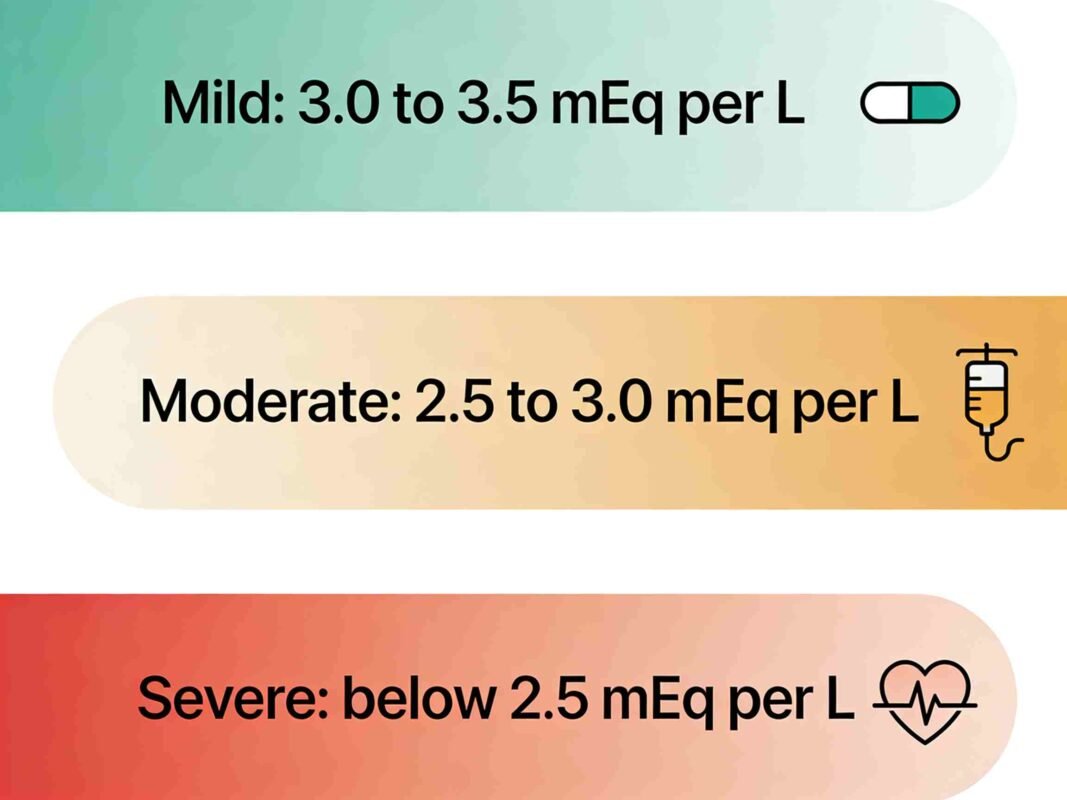
Hypokalemia is defined as serum potassium below 3.5 mEq per L. The Mayo Clinic classifies severity into three levels that directly affect treatment decisions and hypokalemia documentation:
- Mild: 3.0 to 3.5 mEq per L. Often asymptomatic or causes minor fatigue.
- Moderate: 2.5 to 3.0 mEq per L. Muscle weakness and cramping become common.
- Severe: below 2.5 mEq per L. Risk of cardiac arrhythmias, paralysis, and respiratory failure.
Common causes that lead to an E87.6 diagnosis
Diuretic use
Loop diuretics like furosemide and thiazides are the most common cause of hypokalemia. They increase renal potassium excretion, making this the most frequent reason the potassium deficiency code E87.6 appears in clinical records.
Gastrointestinal losses
Vomiting, diarrhea, laxative abuse, and intestinal fistulas deplete potassium rapidly. Prolonged GI losses often require IV replacement alongside the E87.6 code on the encounter record.
Renal losses
Renal tubular acidosis, hyperaldosteronism, and Bartter syndrome cause the kidneys to excrete excess potassium despite low serum levels.
Endocrine disorders
Cushing syndrome and primary aldosteronism increase aldosterone activity, driving renal potassium loss. Both conditions frequently result in an E87.6 diagnosis alongside the endocrine code.
Inadequate dietary intake
Rarely the sole cause but contributory in alcoholism, eating disorders, and extreme caloric restriction. For dietary guidance, see our article on potassium-rich foods.
Magnesium deficiency
Low magnesium impairs potassium retention at the renal level. Correcting hypokalemia without addressing concurrent magnesium deficiency often fails.
Medications beyond diuretics
Insulin, beta-agonists, corticosteroids, and certain antibiotics can shift potassium into cells or increase excretion, triggering a low potassium ICD code encounter.
Clinical symptoms that support the E87.6 diagnosis
- Muscle weakness, cramps, or spasms.
- Fatigue and lethargy.
- Constipation.
- Palpitations and cardiac arrhythmias.
- Polyuria (excessive urination) and polydipsia (excessive thirst).
- Severe cases: paralysis, respiratory failure, cardiac arrest.
Documenting these symptoms in the clinical record strengthens the medical necessity for the hypokalemia ICD 10 code and supports ICD 10 hypokalemia billing accuracy.
Documentation requirements for accurate E87.6 use
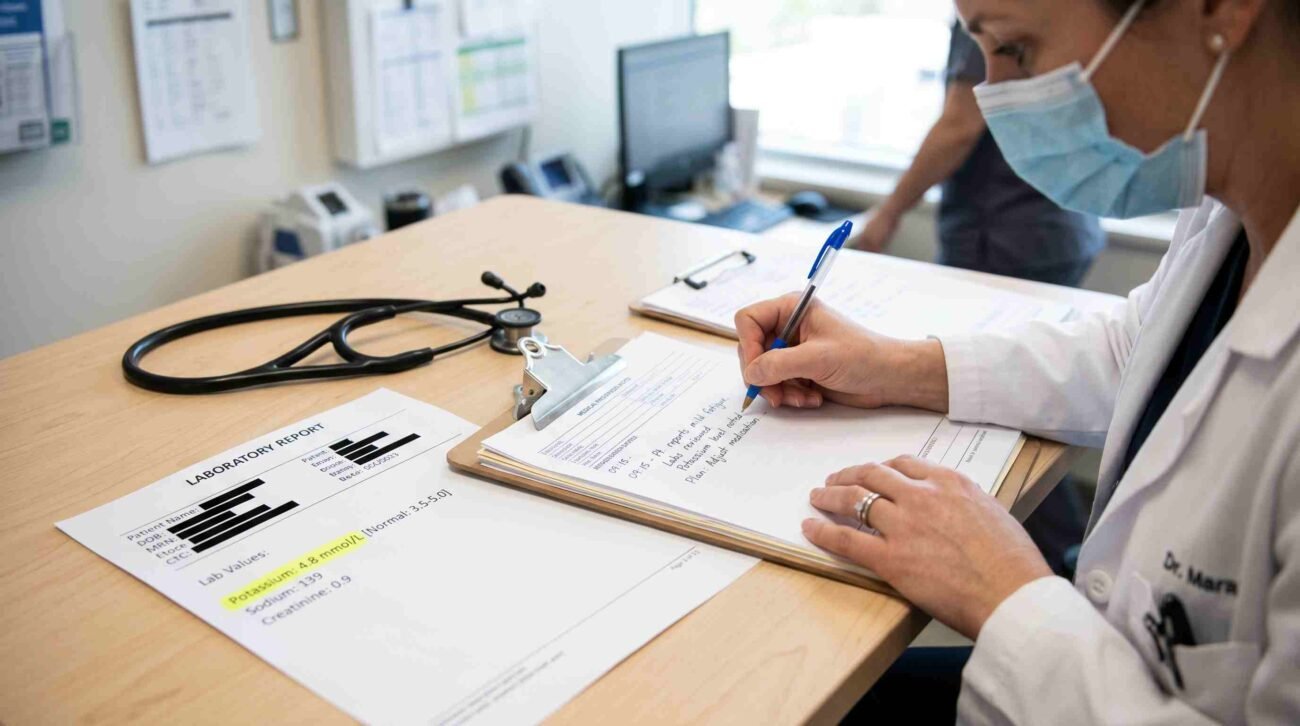
Proper hypokalemia documentation must include:
- Documented serum potassium level below 3.5 mEq per L.
- Clinical significance noted (symptoms, risk factors, or treatment trigger).
- Identification of the underlying cause when known.
- Treatment plan: oral potassium, IV replacement, dietary adjustment, or medication change.
- Follow-up lab orders to confirm correction.
Incomplete hypokalemia documentation is one of the most common reasons for E87.6 coding denials. For foundational billing concepts, see our medical billing essentials guide.
Sequencing and related codes
When E87.6 is the primary diagnosis
Use E87.6 as the principal code when hypokalemia is the main reason for the encounter, such as an admission specifically for IV potassium replacement.
When E87.6 is a secondary diagnosis
List E87.6 alongside the underlying condition when hypokalemia results from another diagnosis. Example: K52.9 (noninfective gastroenteritis) as primary with E87.6 as secondary. For the opposite electrolyte imbalance, see our article on the hyperkalemia ICD 10 code.
Related ICD 10 codes to know
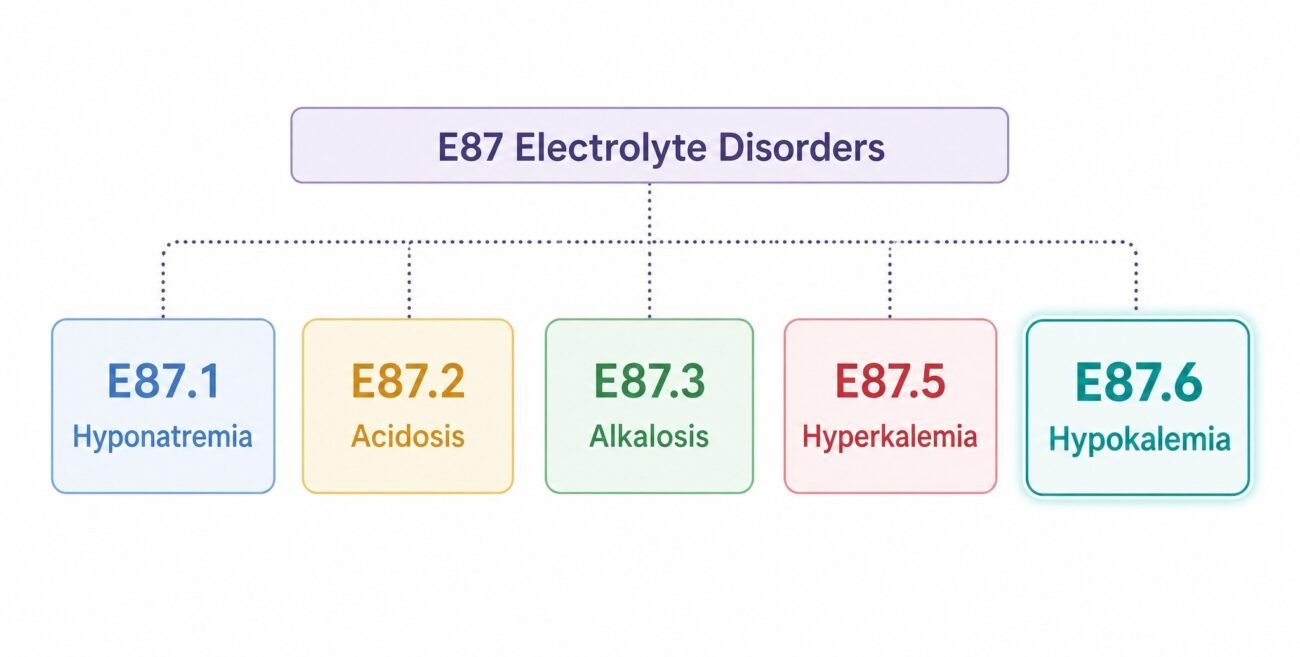
The table below places the E87.6 code alongside other electrolyte disorder codes for quick reference.
| Code | Condition | Key trigger |
| E87.5 | Hyperkalemia | Kidney failure, ACE inhibitors, tissue breakdown |
| E87.6 | Hypokalemia | Diuretics, vomiting, diarrhea |
| E87.1 | Hyponatremia | SIADH, excess water intake, diuretics |
| E87.2 | Acidosis | Renal failure, diabetic ketoacidosis |
| E87.3 | Alkalosis | Vomiting, diuretics, hyperventilation |
Common billing pitfalls
- Coding E87.6 from a single borderline lab value without documented clinical correlation.
- Failing to document the underlying cause when known, which triggers audit flags.
- Confusing E87.6 (hypokalemia) with E87.5 (hyperkalemia). One letter changes the diagnosis completely.
- Omitting potassium replacement documentation weakening medical necessity.
- Not capturing comorbidities that affect hypokalemia management (CKD, heart failure, diabetes).
Treatment overview tied to the diagnosis
- Mild (3.0 to 3.5 mEq per L): oral potassium supplements, dietary adjustment.
- Moderate (2.5 to 3.0 mEq per L): higher-dose oral or low-rate IV replacement.
- Severe (below 2.5 mEq per L) or symptomatic: IV potassium with continuous cardiac monitoring.
- Address magnesium deficiency simultaneously when present.
- Treat the underlying cause to prevent recurrence.
Treatment decisions directly affect whether the potassium deficiency code E87.6 is sequenced as primary or secondary, making clear hypokalemia documentation critical.
Frequently asked questions
Is E87.6 a billable ICD 10 code?
Yes. E87.6 is a billable, specific ICD-10-CM diagnosis code. It does not require additional characters. It is valid for both inpatient and outpatient ICD 10 hypokalemia billing under FY2026 guidelines, effective October 1, 2025, through September 30, 2026.
When does the 2026 version of E87.6 take effect?
The FY2026 ICD-10-CM guidelines, including the E87.6 code, are effective from October 1, 2025, through September 30, 2026. The code itself has not changed from prior fiscal years, but coders should always verify against the current year’s tabular list.
What is the difference between E87.5 and E87.6?
E87.5 is hyperkalemia (high potassium), and E87.6 is hypokalemia (low potassium). They are opposite conditions with different causes, treatments, and clinical urgency. Confusing the two is a common and consequential coding error.
Can hypokalemia be coded from a single low lab value?
Technically, yes, but best practice requires documented clinical significance. A single borderline value without symptoms, treatment, or further workup may not support medical necessity. The Cleveland Clinic notes that clinical context determines whether a low value is clinically meaningful.
What codes pair commonly with E87.6?
Common pairings include N17 to N19 (kidney disease), I50 (heart failure), K52.9 (gastroenteritis), E21 (hyperparathyroidism), and codes for diuretic therapy. Sequencing depends on which condition prompted the encounter.
How is severe hypokalemia documented differently?
Severe hypokalemia (below 2.5 mEq per L) requires documentation of cardiac monitoring, IV replacement rate, and continuous lab rechecks. The E87.6 code remains the same, but supporting documentation must reflect the higher acuity and resources used.
Final thoughts
The hypokalemia ICD 10 code E87.6 is straightforward to assign but requires careful hypokalemia documentation to avoid denials and audit flags. Whether you are coding an IV replacement admission or documenting a secondary finding during a GI encounter, the E87.6 code serves both clinical accuracy and ICD 10 hypokalemia billing integrity. Confirm your lab values, document the cause, record the treatment plan, and verify the code against the FY2026 tabular list. Accurate coding starts with complete documentation.
The information in this article is for educational purposes only and does not replace professional medical advice, diagnosis, or treatment. Always consult a qualified healthcare provider for any concerns about your health or before starting any new treatment. Doctiplus does not endorse specific products, brands, or providers mentioned for illustrative purposes.
References
- Centers for Medicare and Medicaid Services, ICD-10-CM FY2026 Official Guidelines, accessed 2026.
- Mayo Clinic, hypokalemia symptoms, causes, and treatment, accessed 2026.
- Cleveland Clinic, low potassium clinical resource and patient information, accessed 2026.
- National Center for Health Statistics, ICD-10-CM Tabular List 2026 edition.
- American Association of Clinical Endocrinologists, electrolyte management guidelines.
- Journal of Hospital Medicine, hypokalemia coding accuracy and documentation best practices, peer-reviewed.